 Made in Slovakia
 ISO 9001 Made in Slovakia ISO 9001
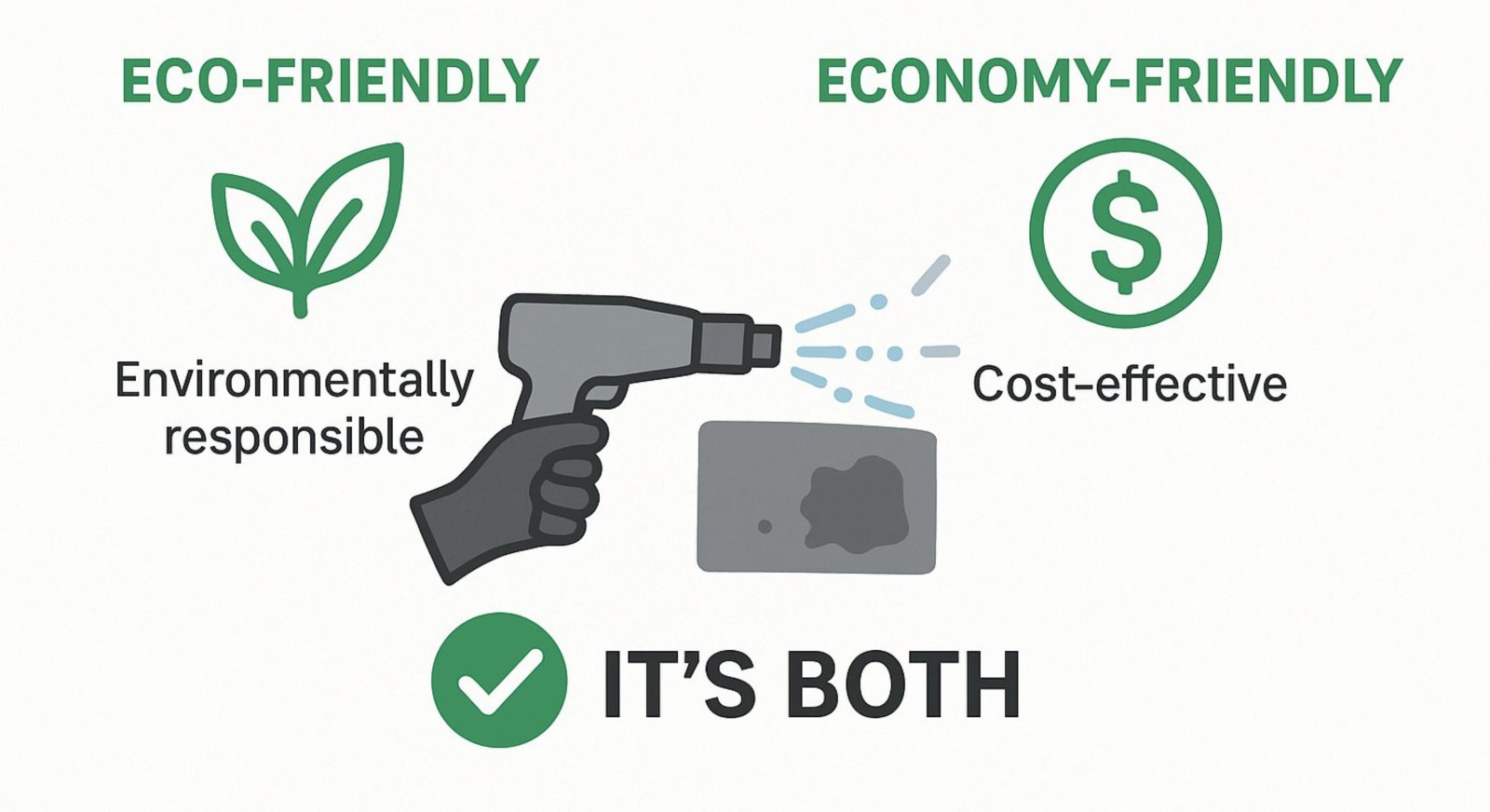 In recent years, dry ice cleaning has become one of the most talked-about industrial cleaning technologies. Companies across manufacturing, food processing, automotive, and heavy industry are turning to it not only for its environmental benefits but also for its potential to reduce operational costs. This raises an important question:
Is dry ice cleaning merely eco-friendly, or is it also economy-friendly?
The answer is clear: it’s both, when applied in the right conditions.
Dry ice cleaning is inherently environmentally responsible. Unlike traditional cleaning methods that rely on harsh chemicals, large volumes of water, or abrasive materials, dry ice blasting uses solid CO₂ pellets made from recycled industrial CO₂. This means it does not introduce new CO₂ into the atmosphere.
Key ecological advantages include:
Dry ice cleaning eliminates the need for toxic cleaning agents, protecting both the environment and worker health.
Because dry ice sublimates upon impact, turning directly from solid to gas, it leaves no residue behind—only the dislodged dirt or contamination.
This makes the process ideal in industries that must avoid moisture, including electrical, food production, and sensitive machinery environments.
With no harmful runoff or chemical discharge, companies can significantly reduce their environmental footprint.
From an ecological standpoint, dry ice cleaning is one of the cleanest industrial cleaning technologies available.
While the eco-friendly benefits are well-known, many companies don’t realize how economically advantageous dry ice cleaning can be. In many scenarios, it significantly reduces operational costs.
Traditional cleaning often requires dismantling machines, stopping production, and waiting for drying or cooling.
Dry ice cleaning can be performed in place, meaning shorter shutdowns and higher productivity.
Dry ice blasting removes contaminants quickly and precisely, reducing labor time and associated costs.
Since dry ice creates no secondary waste, companies avoid costly disposal of chemical wastewater, abrasive media, or contaminated liquids.
Eliminating chemical cleaners reduces recurring costs and compliance requirements.
Dry ice is non-abrasive (unless enhanced with an abrasive module), helping extend the lifespan of machinery and sensitive components.
In industries where machine downtime is expensive, dry ice cleaning frequently pays for itself very quickly.
Dry ice cleaning is not just a sustainability-driven solution—it is a strategic economic advantage for businesses looking to improve efficiency, reduce downtime, and lower waste-related costs. Its combination of ecological responsibility and operational savings makes it a powerful technology for modern industry. Companies that adopt dry ice cleaning are not only reducing their environmental impact—they’re also making a smart investment in long-term cost efficiency.